Lumbar artificial disc replacement can offer a motion-preserving alternative to spinal fusion for carefully selected patients with painful disc degeneration. Yet relatively few spine surgeons perform the procedure regularly.
That is not because lumbar disc replacement lacks value. It is a highly specialized surgery that requires advanced training, precise patient selection, and significant experience with lumbar anatomy and biomechanics.
Understanding why the procedure is less widely available can help patients ask better questions and find a surgeon who offers the full range of treatment options.
Lumbar Disc Replacement Requires Specialized Training
Most spine surgeons are trained extensively in decompression and fusion procedures. These operations remain important and may be the right choice for spinal instability, deformity, severe facet joint degeneration, or other complex conditions.
Lumbar artificial disc replacement requires an additional skill set. The surgeon must understand not only how to remove the damaged disc, but also how to restore disc height, choose the appropriate implant, position it accurately, and preserve balanced movement at the treated level.
Although artificial disc replacement is now an established surgical option for select patients, its adoption has remained more limited than fusion. Published reviews have identified factors such as training requirements, patient-selection concerns, reimbursement issues, and questions surrounding long-term implant performance as obstacles to broader use.
Surgeons who did not receive substantial exposure to lumbar disc replacement during residency or fellowship may continue to rely primarily on the procedures they perform most often.
The Surgical Approach Is More Complex
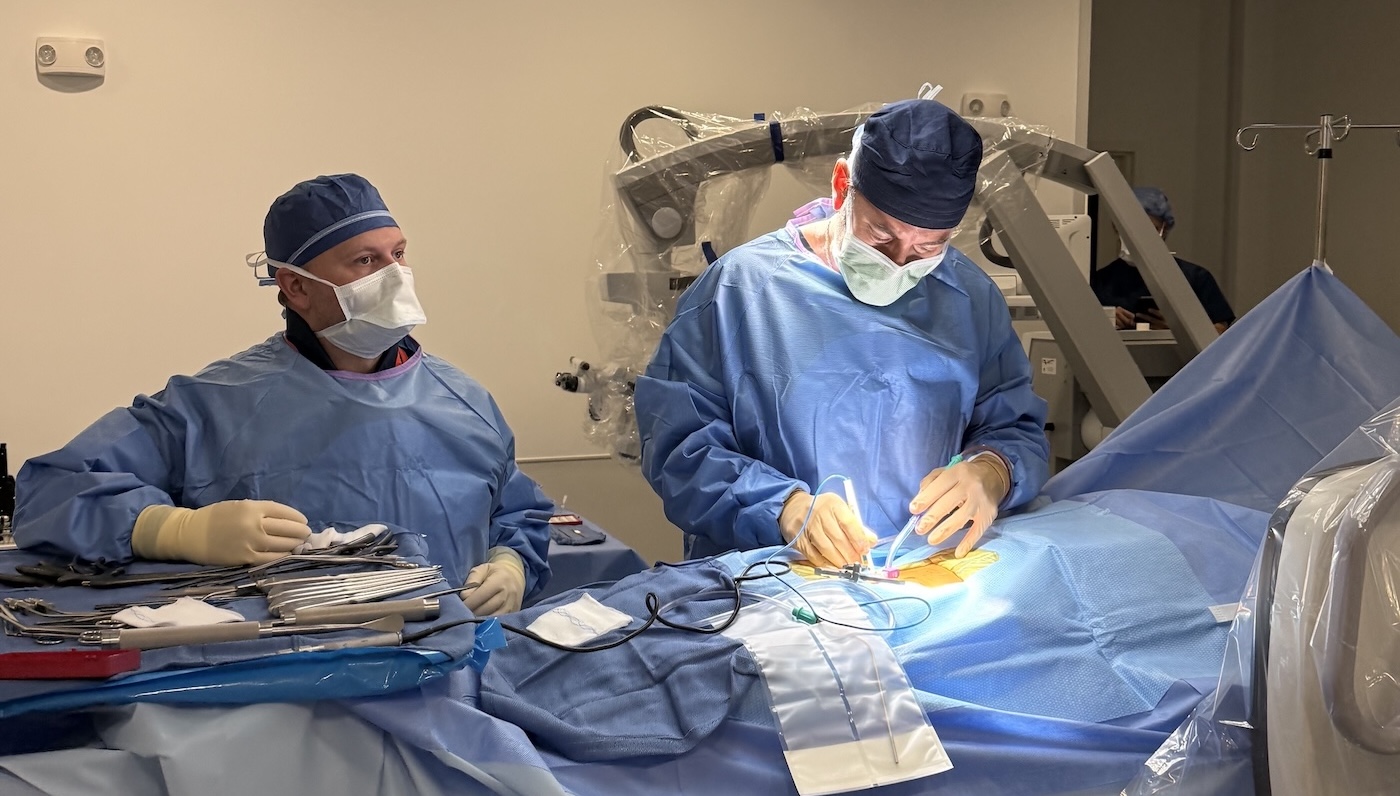
Lumbar artificial disc replacement is typically performed through an incision in the abdomen. This anterior approach provides direct access to the damaged disc but requires careful navigation around major blood vessels, nerves, and abdominal structures.
After removing the damaged disc, the surgeon must position the artificial disc precisely to restore disc height and support balanced movement. This combination of complex access and implant accuracy makes lumbar disc replacement technically demanding.
The Role of an Experienced Vascular Access Surgeon
Because lumbar disc replacement is performed through the abdomen, an experienced vascular access surgeon can be an important part of the surgical team. This specialist helps safely expose the spine by moving and protecting the major blood vessels and other structures in front of the lumbar discs.
Their expertise is especially valuable when the anatomy is complex or the L4-L5 level is being treated, where blood vessel mobilization can be more challenging. Not every city or hospital has a vascular surgeon with extensive experience in anterior spine exposure, which can further limit where lumbar artificial disc replacement is performed.
Patients may want to ask who will perform the surgical exposure and how much experience that surgeon has with anterior lumbar procedures.
Patient Selection Must Be Highly Precise
Lumbar artificial disc replacement is not appropriate for every patient with lower back pain. The surgeon must confirm that the damaged disc is the true pain source and that the surrounding structures can safely support an artificial disc.
A patient may be less likely to qualify when there is:
- Significant facet joint arthritis
- Poor bone density
- Major spinal instability
- Advanced spondylolisthesis
- Significant scoliosis or another spinal deformity
- Infection or tumor
- Pain arising primarily from another structure
- Anatomy that makes the anterior approach unsafe
Because degenerative changes are common on MRI, imaging alone is not enough. Candidacy should be based on the patient’s symptoms, examination, spinal alignment, bone health, and response to prior treatment.
Fusion Remains the More Familiar Option
Lumbar fusion has been performed for decades and remains appropriate for conditions involving instability, severe facet joint damage, or spinal deformity. It is also more familiar to many surgeons, hospitals, and insurers.
Fusion eliminates motion at the treated level, while disc replacement is designed to preserve it. Because many surgeons receive more training and experience with fusion, they may be less likely to evaluate patients for lumbar disc replacement.
Insurance and Administrative Barriers Can Limit Access
Insurance coverage for lumbar artificial disc replacement varies by provider, implant, and number of levels treated. Approval may require documentation showing that the patient:
- Meets specific diagnostic and anatomical criteria
- Has completed appropriate non-surgical treatment
- Is a candidate for an approved implant
- Does not have conditions that make disc replacement unsuitable
The authorization process can be time-consuming, particularly for multi-level surgery. Practices without experience navigating these requirements may be less likely to offer lumbar disc replacement.
Lumbar Disc Replacement Demands Technical Precision
An artificial disc is intended to function as a mechanical joint. Its size, angle, depth, and position can influence how forces are distributed across the treated level.
During surgery, the surgeon must:
- Remove the damaged disc thoroughly
- Preserve enough of the vertebral endplates to support the implant
- Restore appropriate disc height
- Select the correct implant dimensions
- Position the device near the center of rotation
- Confirm placement with real-time imaging
- Protect the nearby nerves, blood vessels, and abdominal structures
An implant placed too far forward, backward, or to one side may not reproduce balanced motion as intended. Excessive removal of supporting bone can also increase the risk of the implant settling into the vertebral body.
These technical considerations help explain why lumbar artificial disc replacement is usually concentrated among surgeons who have made motion-preserving surgery a significant part of their practice.
Some Surgeons Remain Cautious About Long-Term Outcomes
Some surgeons remain cautious about implant wear, migration, subsidence, revision surgery, and how an artificial disc may perform over several decades.
These are reasonable concerns with any permanent spinal implant. However, modern devices, improved surgical techniques, and better patient selection have continued to strengthen lumbar disc replacement outcomes.
Patients should receive a balanced discussion of both disc replacement and fusion rather than being told that one procedure is best for everyone.
Why Experience With Lumbar Disc Replacement Matters
Lumbar artificial disc replacement differs significantly from cervical disc replacement. The lower spine carries greater loads, the surgical approach is more demanding, and the source of back pain can be harder to identify.
Experience matters, but so does surgical volume.
Patients should ask:
- How often do you perform lumbar disc replacement?
- What specialized training have you completed?
- How do you confirm the damaged disc is the pain source?
- Which implants do you use, and why?
- When would you recommend fusion instead?
- How do you manage complications or revision cases?
The goal is to choose a surgeon experienced in both motion-preserving surgery and fusion who can recommend the best option for the individual patient.
Is Lumbar Artificial Disc Replacement Right for You?
Potential candidates often have chronic lower back pain associated with one or two damaged lumbar discs and have not improved sufficiently with appropriate non-surgical care.
However, candidacy cannot be determined from an MRI report or online symptom list. A complete evaluation may include:
- Review of current and previous imaging
- Detailed neurological and physical examination
- Evaluation of the facet joints
- Assessment of spinal alignment and stability
- Bone-density testing when indicated
- Review of previous injections or treatments
- Discussion of health, activity level, and recovery goals
Some patients who seek artificial disc replacement ultimately learn that another treatment would be safer or more effective. Others may discover that they qualify for a motion-preserving option they had not previously been offered.
Schedule a Lumbar Disc Replacement Consultation
Dr. Jason M. Cuéllar is a board-certified, fellowship-trained orthopaedic spine surgeon with advanced training in total disc replacement, motion-preservation surgery, and minimally invasive spine procedures. He trained with leading experts in these techniques at Cedars-Sinai Medical Center and brings extensive experience to the evaluation and treatment of complex lumbar conditions.
Cuéllar Spine welcomes patients from South Florida, across the country, and internationally. Schedule a consultation to learn whether lumbar artificial disc replacement may be right for you.

 Skip to the content